
Your business is working, but maybe not as well as it could be.
Revenue is coming in, and work gets done, but growth and profit aren’t matching effort and pushing harder isn’t fixing it.
It’s rarely an effort problem, usually it’s alignment.
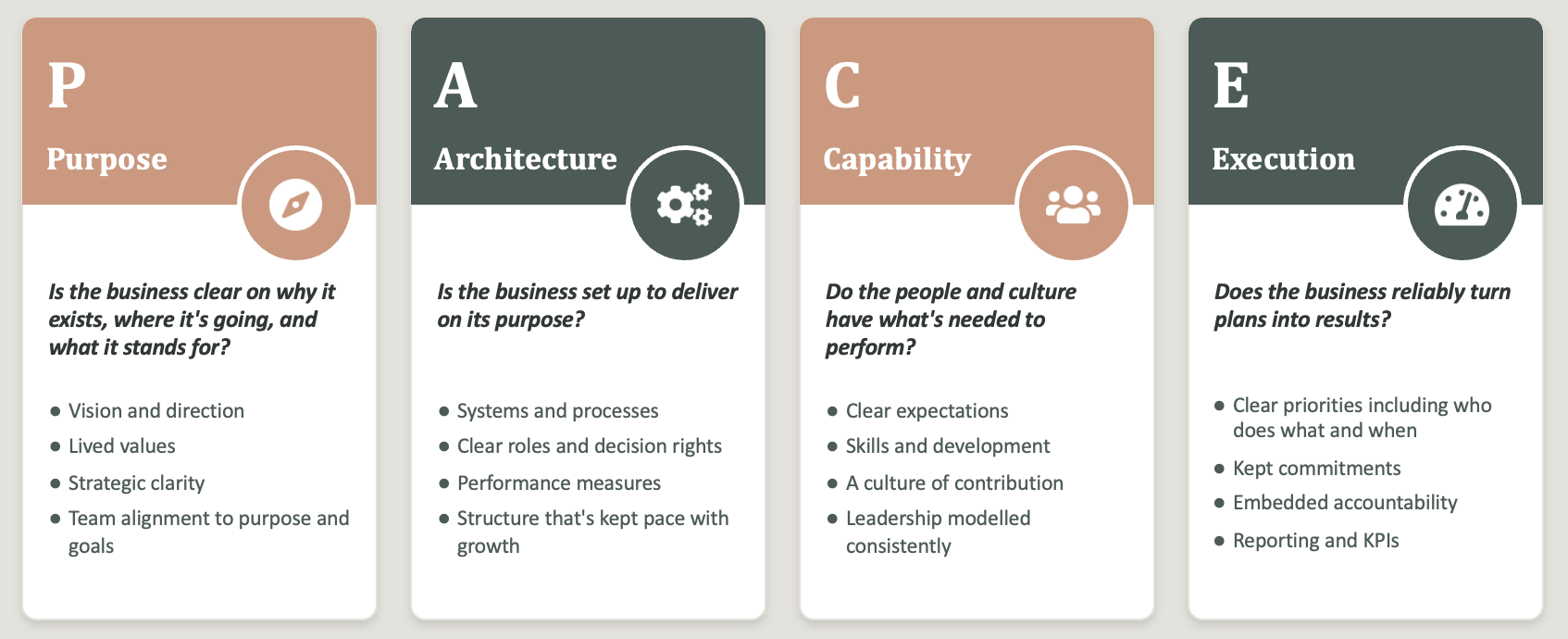
PACE diagnoses business alignment.
When a business isn't getting the results it should, it usually isn't a performance problem. It's an alignment problem.
What the business says it stands for doesn't match how it operates. The structure that got it here isn't the structure it needs now and what the owner thinks is happening isn't what the team is actually experiencing.
Everyone's working hard, nothing looks ‘broken’, but the business is working harder than it needs to for the results it's getting.
The PACE Performance Alignment Model is a structured diagnostic of how your business is performing across the four drivers that determine whether a business is able to deliver on its purpose and potential. It surfaces the misalignments that are limiting results, and gives you a clear, prioritised plan to fix them.
The four PACE pillars
Purpose: why you exist. Is the business clear on why it exists, where it’s going and what it stands for? When direction lives in your head, your team can only react. Signs it’s missing: decisions keep coming back to you, priorities change depending on who you ask, and values are on the wall, not in the work.
Architecture: how you’re built. Is the business set up to deliver on its purpose? Most businesses outgrow their structure before anyone notices. Signs it’s missing: no one is sure who decides what, measures exist but nobody uses them, and the structure looks like it did twenty people ago.
Capability: who can do what. Do your people and culture have what they need to perform? Capability is whether people know what’s expected, are developed, and feel able to speak up and step up. Signs it’s missing: you’re the one still following up and driving results, feedback only comes when things go wrong, and good people leave or quietly settle.
Execution: how work gets done. Does the business reliably turn plans into results? Execution is where priorities hold, commitments are kept and accountability is built in, not chased. Signs it’s missing: deadlines slip without consequence, plans get made then drop off, and meetings end with actions no one tracks.
How it works:
Diagnosing alignment.
Assessment:
Owner self-assessment: a 24-question survey assessing alignment across the four performance drivers
Owner deep dive: A structured two-hour conversation with the founder, owner or MD. I work through each of the four drivers with you, going beneath the surface of how the business actually operates, not just how it looks on paper.
Team survey: 10-15min team survey assessing understanding and alignment across the four performance drivers
Reports and Plan:
Scored Alignment Profile: summarises the owner-assessment score and team survey score for each pillar and provides insight into owner’s experience compared to the experience of those working in the business.
Performance Alignment Report: presents the findings for each PACE pillar. Each pillar shows the owner and team scores, what is working, where performance is being limited, the gap between owner and team perception, and the key insight and priority actions.
90-day Performance Alignment Plan: A focused, prioritised plan showing exactly what to address, in what order, over the next 90 days.
PACE measures the whole system, not only one part of it.
You receive a clear, evidence-based picture of where your business stands and where it’s losing performance as well as the 90-day plan to address the gaps.
PACE questions, answered
-
Three to four weeks from confirmation to your report, and about four hours of your time. No days out of the business.
-
A Scored Alignment Profile out of 120 with owner and team scores side by side, a Performance Alignment Report on each pillar, and a prioritised 90-day Performance Alignment Plan.
-
Yes. You see the themes, never who said what. The gap between what an owner believes is happening and what the team experiences day to day is usually where the most useful insight sits.
-
One fixed fee, agreed in writing. No retainer and no lock-in.
-
PACE suits owners whose business is busy but not growing the way it should, or who are still too central to how it runs. Common signs: every decision still comes back to you, revenue is there but profit isn’t following, or the same conversations keep coming round.
-
PACE scores the business from two sides: your view and your team’s. The gap between them is usually where the most useful insight sits, and it’s the one thing an owner can’t see alone. You get one fixed fee, a written report and a prioritised 90-day plan, with no retainer or lock-in.
-
About four hours of your time over three to four weeks: a 24-question owner self-assessment, a structured deep dive with Faith, and a findings session. Your team completes an anonymous 10 to 15-minute survey. No days out of the business.
-
The fixed fee includes an anonymous team survey for up to 25 people.
-
Yes. You can pay the fee up front, or in two payments: one to start and one before the findings session.
-
Many owners put the plan into practice themselves. If you want support, Stay on PACE adds three sessions plus spot coaching across the 90 days. Bigger findings can lead to a second stage, scoped individually from what PACE uncovers.
-
Faith Styles, founder of Intersect Co, an ICF Professional Certified Coach (PCC) and CPA with more than two decades in senior corporate roles. Most people who can read your numbers can’t read your team. Faith does both.
Ready to act:
The first step is a scoping conversation, a direct, no-obligation discussion about your business and whether the assessment is the right fit.
If you'd like to see the output first, download a sample Performance Alignment Report.